
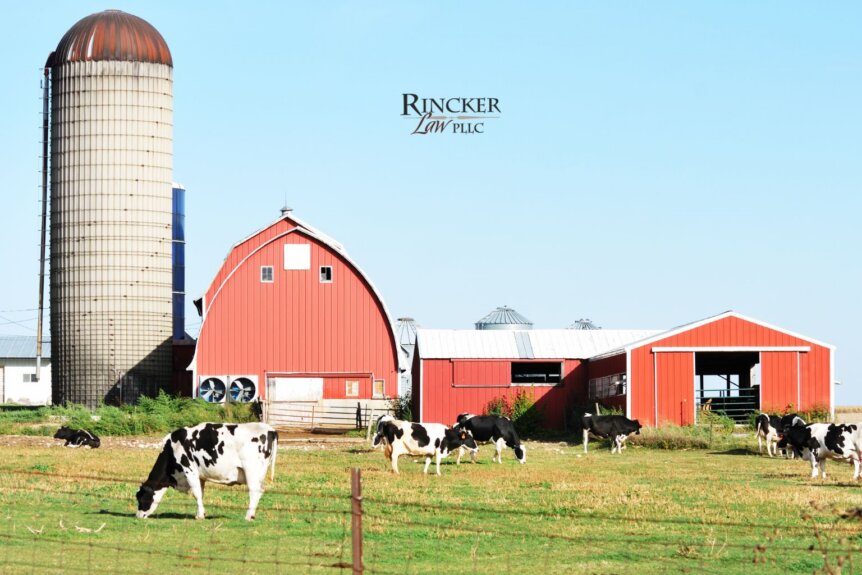
2027 Illinois Farm Leases: What Landowners and Farmers Should Negotiate Before Harvest Ends is a conversation many Illinois farmers and farmland owners should be having before the combines are parked for the season. Farm lease discussions often happen in the fall, but waiting until the last minute can leave both sides rushing through important decisions involving rent, expenses, improvements, conservation practices, and the future use of the land.
The economic environment makes those conversations particularly important heading into 2027. University of Illinois farmdoc reports that Illinois cash rents remained relatively strong in 2026, while most farm managers surveyed expected 2027 rents either to remain approximately unchanged or increase slightly. At the same time, high input costs and pressure on farm profitability continue to make lease terms an important part of a farm operator’s financial planning.
A farm lease should do more than state the number of acres and the rent. It should clearly explain what each party expects before another crop goes into the ground.
1. Decide Whether the Rent Structure Still Makes Sense
The first question is not simply, “What should the rent be?”
Landowners and tenants should also consider how the rent should be calculated.
A traditional fixed cash lease provides predictability. The tenant generally pays an agreed amount per acre regardless of the crop’s ultimate yield or market price.
A flexible cash lease may establish a base rent with an additional payment if agreed-upon yield, price, or revenue benchmarks are reached. A flexible cash lease can allocate some price and yield risk differently than a fixed cash lease, depending on the formula the parties select.
Crop-share arrangements allocate certain production costs and crop proceeds between the parties.
There is no single lease structure that works best for every Illinois farm. Soil productivity, drainage, location, historical yields, commodity prices, management responsibilities, and the parties’ appetite for risk should all be considered.
2. Do Not Set Rent Based Only on What the Neighbor Is Paying
It is tempting to negotiate farmland rent based on what someone heard another farmer is paying down the road.
That can be misleading.
Farmdoc has reported significant variation among cash rents even within the same land-quality categories. Rates can vary substantially based on the quality and characteristics of the particular farmland.
A reasonable rent may depend on factors such as:
- Soil productivity
- Historical yields
- Drainage and tile
- Field size and shape
- Location and accessibility
- Fertility levels
- Improvements
- Local competition for farmland
- Expected crop revenue
- Input expenses
The highest cash rent is not automatically the best lease for the long-term health of the farm relationship.
3. Spell Out Fertilizer and Soil Fertility Responsibilities
Fertilizer costs can be substantial, and disagreements sometimes arise when the lease does not clearly state who is responsible for maintaining soil fertility.
Monitoring phosphorus, potassium, and pH levels can be important because declining fertility may affect both future yields and the long-term productivity of the farmland. Under many cash-rent arrangements, the farm operator pays those input expenses, but the lease itself should clearly address the parties’ responsibilities.
Landowners and tenants may also want to address soil testing, lime application, manure, nutrient management, and whether fertility levels should be maintained according to an agreed standard.
4. Address Drainage, Tile, Buildings, Fences, and Improvements
Who pays when a drainage tile fails?
What if the tenant wants to install new tile?
Who repairs a farm building, access road, well, or fence?
Those questions are much easier to answer before a problem occurs.
A written farm lease can specify who is responsible for routine maintenance and how larger capital improvements will be handled. If a tenant contributes money toward a long-term improvement, the parties may also want to address what happens if the lease ends before the tenant receives the anticipated benefit.
5. Discuss Conservation and Farming Practices
Conservation provisions are becoming an increasingly important part of farm lease negotiations.
The parties may wish to address cover crops, tillage practices, waterways, erosion control, nutrient management, conservation programs, or other land-management decisions.
Those expectations should not be left to assumption.
University of Illinois farmdoc provides model lease forms and a Soil Health and Conservation Addendum that parties may adapt to address these issues.
If conservation programs involve government payments, cost sharing, multi-year commitments, or restrictions on land use, the lease should also identify which party has authority to enroll the land and how benefits and obligations will be allocated.
6. Clarify Insurance and Liability
Farm leases should address insurance expectations as well.
Depending on the operation, the parties may want to consider general liability coverage, property coverage, crop insurance, and insurance relating to employees, livestock, equipment, or other activities on the property.
The lease may also allocate responsibility for particular risks and require proof of insurance.
Simply assuming that “the other person’s insurance will cover it” can create an unpleasant surprise after an accident.
7. Put the Agreement in Writing
Handshake agreements remain part of agricultural culture, but a written lease provides far more certainty.
A good written agreement can identify the property, lease term, rent, payment deadlines, farming practices, expenses, maintenance obligations, insurance requirements, improvement procedures, and termination provisions.
University of Illinois farmdoc publishes several Illinois farmland leasing forms that parties can use as starting points. Individual leases, however, may need modifications to fit the particular landowner, tenant, property, and farming arrangement.
A form should therefore be treated as a starting point—not necessarily the finished agreement.
8. Pay Attention to Illinois Farm Lease Termination Rules
One of the most important issues to address before harvest ends is whether an existing lease will continue into 2027.
Illinois law provides specific notice requirements for terminating certain year-to-year farm tenancies. Under 735 ILCS 5/9-206, written notice to terminate a year-to-year farm tenancy generally must be provided at least four months before the end of the lease year.
The statute applies to farmland rented on crop-share, livestock-share, cash-rent, or other rental arrangements and specifically provides that the notice requirement cannot be waived in a verbal lease.
The exact deadline depends on when the particular lease year ends.
That is why landowners who are thinking about changing tenants—and tenants who are uncertain about their future rights—should review the lease well before the end of the year rather than relying on a general rule of thumb.
Frequently Asked Questions About 2027 Illinois Farm Leases
Are Illinois cash rents expected to increase in 2027?
Current survey information suggests relative stability. Farmdoc has reported that most surveyed farm managers expected 2027 cash rental rates to remain similar to 2026, although actual rents may vary substantially depending on location, soil quality, expected returns, and the individual farm.
Is an oral farm lease legal in Illinois?
Oral farm leases can create enforceable tenancy relationships, but they also create greater opportunities for disagreement about the terms. Written leases are generally preferable because they document the parties’ expectations.
Can a landlord simply tell the farmer after harvest that the lease is over?
Not necessarily. Year-to-year Illinois farmland tenancies may be subject to statutory written-notice requirements. The lease terms and the specific facts should be reviewed before assuming that a tenancy has been properly terminated.
Should a farm lease be reviewed every year?
Even when the parties have a long-standing relationship, it is wise to periodically review the agreement. Rent levels, farming practices, ownership, conservation programs, insurance, and family succession plans can change over time.
Start the 2027 Farm Lease Conversation Before Harvest Is Over
A productive farm lease relationship often depends on communication just as much as the written agreement itself. Waiting until winter to discover that the landowner and farmer had very different expectations for 2027 can create unnecessary conflict.
Rincker Law, PLLC assists Illinois farmers, farmland owners, and agricultural businesses with farm leases, farm business agreements, succession planning, and other agricultural legal matters.
If you are negotiating, renewing, changing, or terminating an Illinois farm lease for the 2027 crop year, contact Rincker Law, PLLC at (217) 774-1373 to discuss your situation.
Disclaimer: This article is for general informational purposes only and does not constitute legal advice. Farm lease rights and obligations depend on the specific agreement and circumstances involved. Reading this article does not create an attorney-client relationship.