
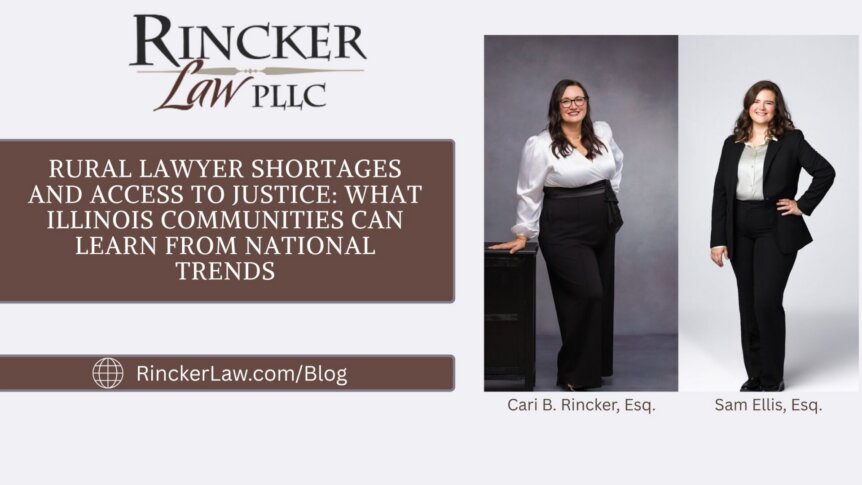
Rural Lawyer Shortages and Access to Justice: What Illinois Communities Can Learn From National Trends examines a growing challenge facing small towns and rural communities throughout Illinois and across the country. In the July 2026 issue of the Illinois State Bar Association’s Rural Practice newsletter, Rincker Law attorneys Cari Brett Rincker and Sam Ellis co-authored “Rural Law Practice in the News,” an overview of recent efforts to address legal deserts, strengthen rural legal services, and recruit attorneys to underserved communities. Cari also serves as a co-editor of the Rural Practice newsletter.
The developments highlighted in the article show that rural attorney shortages are not limited to one state or one area of law. Communities across the United States are exploring financial incentives, mentorship programs, alternative licensing pathways, court-navigation resources, and other approaches designed to improve access to legal assistance.
What Is a Rural Legal Desert?
The term “legal desert” generally describes a community with too few attorneys to meet the legal needs of its residents. In some rural areas, residents may have difficulty finding any nearby lawyer. In others, attorneys may be available, but there may not be enough lawyers practicing in essential areas such as family law, estate planning, real estate, agricultural law, criminal defense, probate, or business law.
The problem involves more than the total number of licensed attorneys in a state. Where those lawyers are located matters. A state may appear to have an adequate number of attorneys overall while most of them are concentrated in major metropolitan areas.
Rural residents may therefore have to travel significant distances, wait longer for assistance, or proceed without representation. These barriers can affect families, farmers, business owners, crime victims, defendants, seniors, and others who need timely legal guidance.
Illinois Continues Investing in Access to Justice
The newsletter article discusses the Illinois Courts Access to Justice Improvement Grant Program. For the 2026–2027 funding cycle, Illinois courts were invited to propose projects that would make the justice system more accessible to people representing themselves.
Potential initiatives included courthouse self-help centers, clearer courthouse signage, early-resolution programs, and partnerships with public libraries. These resources can be especially valuable in rural communities where legal aid organizations and private attorneys may be limited.
The article also highlights the Illinois Court Navigator Network. This network connects courthouse staff, Illinois JusticeCorps members, Illinois Court Help guides, and other access-to-justice professionals so they can exchange resources and effective strategies.
These programs are not intended to replace private attorneys. Instead, they can help people better understand the court system, locate appropriate resources, and navigate basic procedures when representation is unavailable.
Neighboring States Are Testing New Solutions
Illinois is not alone in confronting rural attorney shortages. The article reviews several programs and policy discussions taking place in other states.
In Iowa, attorneys, lawmakers, and community leaders gathered to discuss how to attract and retain lawyers in rural areas. According to information cited in the newsletter, nearly half of Iowa’s 99 counties have 10 or fewer attorneys, and 17 counties have fewer than five.
Indiana has created a Rural Practice Academy focused on helping attorneys establish sustainable practices in rural and underserved communities. The inaugural class includes 15 lawyers who will receive training, mentorship, and practical guidance throughout the year.
The Indiana program is notable because it focuses not only on placing lawyers in rural areas but also on helping them remain there. Starting or joining a rural practice can require knowledge of law firm management, community relationship building, technology, staffing, and financial planning. Mentorship and professional support may help attorneys build practices that can serve their communities for many years.
Public Defense Shortages Affect the Entire Justice System
The lack of rural lawyers also affects public defense and prosecution systems. When courts cannot find enough qualified attorneys to represent defendants or handle prosecutions, cases may be delayed and existing attorneys may become overwhelmed.
The newsletter discusses several state-level efforts designed to address these shortages, including loan repayment programs, rural legal training programs, and educational incentives for attorneys who agree to practice in underserved communities.
The issue is not merely one of economic development. Access to qualified criminal defense counsel is a constitutional concern. A shortage of prosecutors and public defenders can also affect victims, witnesses, court personnel, and public confidence in the justice system.
Could Alternative Licensing Help Rural Communities?
Some states are considering whether changes to attorney licensing could create additional pathways into rural practice.
In New Mexico, state leaders have discussed a supervised-practice pathway that could serve as an alternative to relying exclusively on the traditional bar examination. The article notes that four New Mexico counties do not have a single lawyer and that many of the state’s attorneys are concentrated in Albuquerque, Santa Fe, and Las Cruces.
Tennessee has also hosted discussions involving judges, attorneys, scholars, and other professionals about rural attorney shortages, alternative licensing, and whether trained non-lawyer professionals could assist with certain unmet civil legal needs.
Any changes to licensing or legal-service delivery would require careful safeguards. However, these discussions reflect the urgency of the problem and the need to consider solutions beyond traditional attorney recruitment.
Technology Alone Cannot Solve the Rural Justice Gap
Online legal information, virtual meetings, and electronic court services can improve access for many people. However, technology is not a complete solution.
Rural communities may face limited broadband access, lower levels of digital literacy, transportation barriers, and difficulty accessing trusted local resources. Some legal matters also require personalized advice that cannot be replaced by a website or automated form.
National research discussed in the newsletter recommends looking at rural access to justice as a service-design challenge rather than simply counting attorneys. Different communities may require different combinations of solutions, including court navigators, legal aid partnerships, improved intake systems, local referral networks, technology investments, and programs encouraging attorneys to establish private practices in rural areas.
Rural Practice Offers Meaningful Opportunities
Although rural attorney shortages create serious challenges, they also create opportunities for attorneys who want to build meaningful careers.
A rural lawyer may become a trusted advisor to families, farms, small businesses, local governments, and community organizations. Attorneys in rural areas often handle a broader variety of matters and develop long-standing relationships with their clients.
Programs involving mentorship, loan repayment, professional networking, and law practice management may help a new generation of attorneys recognize the professional and personal benefits of rural practice.
Strengthening rural legal services will require cooperation among courts, bar associations, law schools, government leaders, private law firms, and the communities they serve.
Read the Full Rural Practice Newsletter
The July 2026 issue of the ISBA Rural Practice newsletter includes the complete “Rural Law Practice in the News” article by Sam Ellis and Cari Brett Rincker, along with additional articles about artificial intelligence costs, minor guardianship in Illinois, and the experiences of rural practitioners.
Download and read the full newsletter here.
Contact Rincker Law
Rincker Law, PLLC understands the importance of accessible legal services for rural families, farmers, landowners, and businesses. The firm assists clients with matters involving agriculture, estate planning, guardianship, family law, business law, real estate, and other issues affecting rural communities.
To discuss your legal needs with Rincker Law, PLLC, call (217) 774-1373.
This article is provided for general informational purposes only and does not constitute legal advice. Reading this article does not create an attorney-client relationship. Every legal matter is different, and individuals should consult a licensed attorney regarding their specific circumstances.