
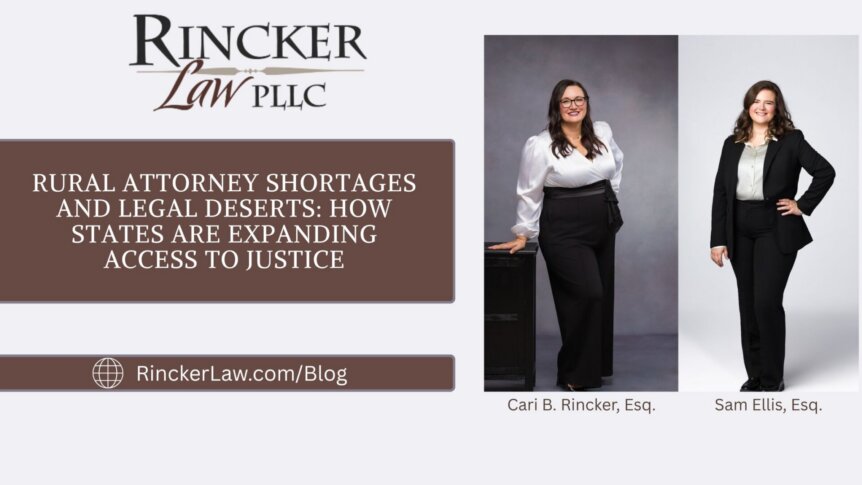
Rural Attorney Shortages and Legal Deserts: How States Are Expanding Access to Justice examines a growing challenge facing rural America. Many rural communities do not have enough attorneys to meet the legal needs of residents, farmers, families, and local businesses.
Rincker Law attorneys Sam Ellis and Cari Brett Rincker recently examined several efforts aimed at addressing this problem, including expanded access-to-justice funding in Illinois, a rural practice academy in Indiana, financial incentives for attorneys in Kansas, and technology-based service models developing across the country.
Although these programs take different approaches, they share a common goal: improving access to legal services in communities where attorneys and legal resources may be limited.
What Is a Rural Legal Desert?
A “legal desert” generally refers to a geographic area with too few attorneys available to serve the local population. Although definitions and measurement methods vary, the underlying problem is consistent: people living in rural communities may have difficulty finding timely, affordable, and experienced legal representation.
Attorney shortages can affect nearly every aspect of rural life. Residents may need help with estate planning, probate, family law, real estate transactions, business formation, employment matters, agricultural contracts, farm succession planning, or disputes involving land and natural resources.
The effects can be particularly serious for farmers, ranchers, and agricultural businesses. A family farm may involve overlapping legal issues concerning land ownership, leases, business entities, taxes, succession, debt, environmental regulation, and family relationships. When qualified legal counsel is unavailable, important decisions may be delayed until a disagreement, financial problem, or emergency arises.
Rural legal deserts can also place additional pressure on the attorneys who remain. Lawyers practicing in smaller communities may handle a broad range of matters, travel significant distances, and serve clients across several counties. When an experienced rural practitioner retires without a successor, the community may lose not only a law office but also decades of local knowledge and trusted relationships.
Illinois Expands Access-to-Justice Funding
In April 2026, the Illinois Supreme Court Commission on Access to Justice announced approximately $400,000 in grant funding for 26 organizations working to improve meaningful participation in the court system.
The funded initiatives include community-based legal clinics, expanded pro bono services, remote access to courts, language-access programs, mediation services, and assistance for self-represented litigants.
These programs are especially important in rural communities, where residents may face long travel distances, limited public transportation, unreliable internet access, and fewer nearby legal service providers.
Illinois has also continued to develop its Court Navigator Network. The Network connects court personnel and access-to-justice professionals throughout the state so they can share resources, receive training, and create programs for individuals who must navigate the court system without an attorney.
Participating courts may implement initiatives such as self-help stations, clearer courthouse signage, remote-hearing assistance, text-message reminders, mediation programs, plain-language materials, and partnerships with local libraries, legal aid organizations, and attorneys.
These efforts recognize that access to justice depends on more than the number of lawyers practicing in a county. It also depends on whether residents can understand court procedures, locate reliable resources, attend hearings, and obtain help when they cannot afford or immediately locate private counsel.
Indiana Creates a Rural Practice Academy
Indiana is addressing rural attorney shortages through a workforce-development approach.
The Indiana State Bar Association launched a Rural Practice Academy designed to encourage attorneys to build sustainable practices in underserved rural communities. The year-long program focuses on mentorship, professional development, law practice management, and connections with local communities.
Rather than relying only on short-term placement incentives, the Academy seeks to develop long-term interest in rural practice. Participants receive practical support intended to help them understand how to operate a law firm, establish relationships in a smaller community, and serve clients across a range of legal matters.
Programs of this kind may also help established rural law firms recruit associates and plan for succession. Many experienced attorneys in rural areas are approaching retirement but have difficulty finding younger lawyers who are prepared to take over their practices or serve their existing client base.
Connecting early-career attorneys with mentors and communities that need legal services may reduce some of the financial and professional uncertainty associated with starting a rural practice.
Mentorship is particularly valuable because rural attorneys often practice in multiple areas of law rather than focusing on a narrow specialty. A younger lawyer may need guidance not only on substantive legal issues but also on law firm management, client relationships, community involvement, and the practical realities of serving a large geographic area.
Kansas Offers Financial Incentives for Rural Practice
Kansas has taken a more direct financial approach through the Attorney Training for Rural Kansas Act.
The program provides financial assistance to qualifying law students and practicing attorneys who agree to live and work in rural parts of the state. Benefits may include tuition assistance for law students and student loan repayment for attorneys who make qualifying rural-practice commitments.
Student debt can make rural practice difficult for newer attorneys, particularly when salaries in smaller communities may be lower than those offered by large firms or metropolitan employers. Loan repayment and tuition assistance can help reduce that financial pressure.
The Kansas model also acknowledges that rural attorney shortages are not merely a temporary recruitment problem. They are part of a broader succession and infrastructure challenge.
As longtime rural attorneys retire, communities need new lawyers who are willing to establish roots, build relationships, and remain for the long term. Financial incentives may help attract attorneys initially, but professional support, mentorship, and community integration will remain important for retention.
National Data Shows That Legal Deserts Can Persist
Recent research continues to demonstrate that rural legal deserts are often structurally persistent.
Once a county experiences a serious attorney shortage, it may be difficult to reverse the trend. Fewer attorneys can mean fewer opportunities for mentorship, employment, succession, and professional collaboration. That, in turn, may make the community less attractive to younger lawyers considering where to begin their careers.
Attorney shortages may also grow worse as the existing legal workforce ages. If no successor is available when a rural practitioner retires, clients may be forced to travel to another county or rely on attorneys who are already managing heavy caseloads.
This is why isolated recruitment efforts may not be enough. Sustainable solutions may require coordination among courts, state legislatures, bar associations, law schools, legal aid organizations, local governments, and private law firms.
Technology Can Improve Rural Legal Access
Technology is increasingly important in efforts to serve rural communities.
Remote consultations, electronic filing, virtual hearings, online self-help resources, and regional collaborations can reduce the effect of distance. A rural resident may be able to consult with an attorney without taking an entire day away from work or traveling several hours.
Technology can also help lawyers serve clients across a wider geographic region and collaborate with courts, libraries, community organizations, and legal aid providers.
However, technology is not a complete solution. Some rural residents lack reliable broadband access, suitable devices, or the confidence to navigate online systems. Other legal matters require in-person communication, courtroom appearances, local knowledge, or a continuing relationship with an attorney.
The most effective models will likely combine technology with local partnerships and a stronger pipeline of attorneys committed to rural practice.
Rural Practice Offers Meaningful Opportunities
The discussion surrounding rural legal deserts often focuses on shortages, but rural practice can also offer substantial professional opportunities.
Attorneys in rural communities may gain significant courtroom and client-management experience early in their careers. They may build closer relationships with clients, participate in community leadership, and develop practices that serve several interconnected areas of law.
Rural attorneys can also have a visible impact on the communities they serve. Their work may help families transfer farms to the next generation, assist small businesses with growth, resolve land disputes, guide residents through estate administration, or protect local institutions.
For attorneys interested in autonomy, community involvement, and varied legal work, rural practice may provide a rewarding career path.
Strengthening Legal Services in Rural Communities
Addressing rural attorney shortages will require more than one program or funding source.
Financial incentives can make rural practice more economically realistic. Mentorship and training can help attorneys build sustainable practices. Court navigators and legal aid partnerships can assist self-represented litigants. Technology can reduce travel barriers. Succession planning can help preserve established rural law practices when senior attorneys retire.
Together, these efforts can improve access to justice while strengthening the communities that depend on rural attorneys.
Contact Rincker Law, PLLC
Rincker Law, PLLC works with farmers, ranchers, agribusinesses, families, and rural business owners on matters involving food, farm, and family law.
To discuss your legal needs with a member of the Rincker Law team, call (217) 774-1373 or contact the firm through its website.
This article was adapted from “Rural Law Practice in the News,” written by Sam Ellis and Cari Brett Rincker and originally published as the cover article in the June 2026 issue of the Illinois State Bar Association’s Rural Practice newsletter. Cari Brett Rincker also served as a co-editor of the publication.
Legal Disclaimer
This article is provided for general educational and informational purposes only and does not constitute legal advice. Reading this article does not create an attorney-client relationship, and readers should consult qualified legal counsel regarding their specific circumstances.